
Projects
Here’s a quick overview of the different topics we’re working on at the moment.
Featured

CMMDE is a Python-based toolkit designed for running computational jobs and handling the analysis, visualization, and post-processing of results. It supports free and open-source applications, focusing on computational molecular and material design, enabling streamlined workflows in research and development.

Batteries are a key focus of research at SaktiLab, particularly the development of eco-friendly solid polymer electrolytes using cellulose. The lab investigates lithium-ion mobility and intermolecular interactions within these materials through computational simulations, aiming to enhance performance and sustainability in energy storage technologies.
More

We investigate the ionic conductivity of ASSLBs and Li-In alloys using MD simulations, in particular the interfacial reaction between In and LPSCI.

Lithium-sulfur batteries are a promising alternative to traditional lithium-ion technology due to their high energy density, lightweight design, and lower cost. Utilizing sulfur as the cathode allows for greater storage capacity. However, key challenges include short cycle life and capacity fading, primarily caused by polysulfide shuttling during charge and discharge cycles. Research focuses on addressing these issues to unlock their full potential for energy storage.

Bone Morphogenetic Protein Receptor type II (BMPR2) is a receptor of bone forming protein and a transmembrane protein that forms dimer. It is known that certain BMPR2 mutations cause Pulmonary Arterial Hypertension (PAH). However, there is no effective treatments for PAH against mutated BMPR2. The purpose of this research is to search for candidate compounds for mutant BMPR2 and and analyze their interactions with BMPR2.

NASICON, Na super Ionic Conductors for short, has compositional formulas which contain metal and polyanion NaxM2(AO₄)3. The purpose of this research is to search for solid-state electrolytes with higher ionic conductivity and less toxic atoms using Density Functional Tight Binding Molecular Dynamics (DFTBMD).

This research aims to explore the molecular-level interactions between sodium ions and graphene oxide within an electrolyte system. The study focuses on understanding the structural evolution and stability of graphene oxide during sodium-ion intercalation. Additionally, it seeks to identify key factors that influence the electrochemical performance of graphene-based anodes in sodium-ion batteries, aiming to improve energy storage capabilities.
In recent years, global warming has had serious impacts on the Earth’s environment, and the increase in atmospheric CO₂ concentration is considered one of its major causes. Carbon capture and storage is one promising approach to reducing CO₂ levels. Ionic liquids (ILs) have attracted considerable attention as CO₂ capture media; however, their toxicity, low biodegradability, and high cost remain significant drawbacks. Natural deep eutectic solvents (NaDES), which are composed of Brønsted acids and bases, are environmentally friendly and less sensitive to impurities than ILs. Therefore, NaDES have recently attracted attention as promising materials for CO₂ capture.
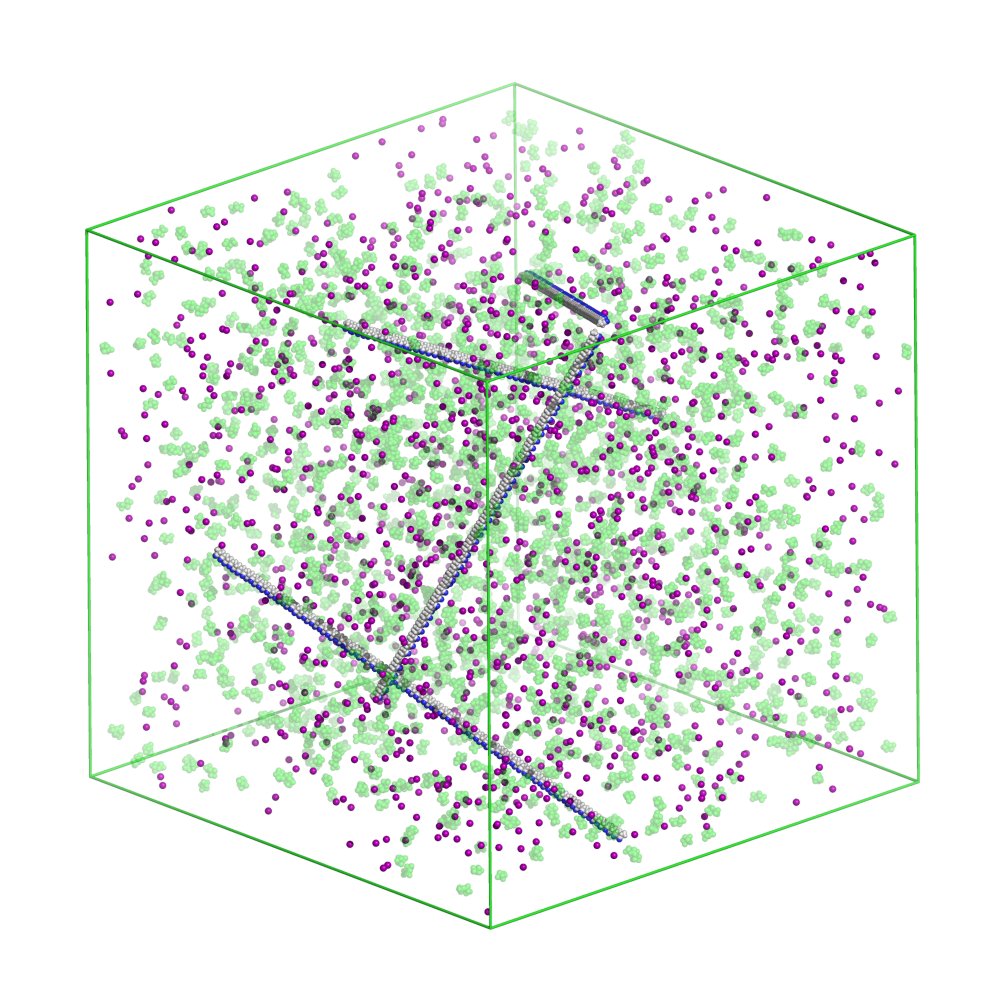
Using atomistic Molecular Dynamics (MD) simulations, we design safer, next-generation energy storage materials, specifically focusing on gel polymer electrolytes. By modeling a high-performance system of polyacrylonitrile (PAN) paired with the asymmetric salt LiFTFSI, we uncovered that lithium-ion transport is driven by a rapid “ion-hopping” mechanism mediated by the anions rather than the polymer matrix itself. This structural insight—validated by a perfect match with experimental conductivity data—reveals exactly how molecular-level tuning can optimize ion transport, paving the way for the rational design of high-conductivity solid-state batteries.